Are You Forgetting Your Face When You Write?

When you finish your writing session, are you frowning? Are your lips compressed or pursed forward? Are you gritting your teeth? Are you biting the inside of your mouth? Are your lips pulled to one side? Do your eyes feel heavy?

When we write, we often end up with tight muscles all through the body: shoulders scrunched up, body core slumped, chin pressing forward.

Just as we forget about our body as it gets stuck in a less than healthy position while we write, it doesn’t occur to us to think about what’s happening in our faces.

Unless you’re a writer who can’t bear to ignore a ringing phone, your facial muscles might remain immobile (i.e., stuck!) for long periods of time.

I’ve been writing long hours the last few months and noticed I not only finish my writing session with my face tight, but I wake up in the morning gritting my teeth.

So I thought it was time to check out some facial exercises. There’s some pretty unattractive vocabulary around facial exercises (sagging, drooping, aging….), but I ignored all that. What I was looking for were exercises that would keep my facial muscles lively!

A couple of my favorites Continue reading
Paying Attention: The Art of Noticing

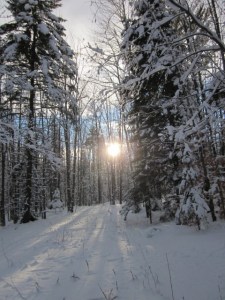
setting sun in woods, Eastern TownshipsI finally make myself get into my boots, gloves, hat, neck roll, big coat, boot grippers and go to the gym. Head down, I lean into -24 C. Stop in my tracks. Feel the cold on my face, the icy wind, the stinging hail-like snow. Become aware of a strange creaking sound – the city is creaking all around me. No blaring horns and whooshing tires and squealing brakes from the passing traffic, just this strange creak of snow under tires. Beyond the creak – silence. What am I doing? I’m marking out a moment. Last year raced by. So often days became a blur. I’d finish one thing, rush on to the next.

Every day includes much more non-being than being. This is always so. One walks, eats, sees things, deals with what has to be done; the broken vacuum cleaner; ordering dinner; washing; cooking dinner. When it is a bad day the proportion of non-being is much larger. Virginia Woolf

So my new year’s resolution? Carve out a moment of being every day. And that means a moment of being attentive to the details of what I am doing, thinking, sensing.  I thought I would start by taking up journal writing again but this great article by Keri Smith gave me a better plan: the idea of ‘fives’. Every day I would write down five particular moments I had noticed. No sooner had I started than I changed my rules! Instead of ending the day wondering what moments I could remember, I would actively search for my moments. Every evening I would choose a focus or theme for the day. This could be : Continue reading

Snow Rage: Writing Lesson From A Snowy Sidewalk

I’m clumping along on my ‘grippers’ – grampons attached to boots for icy sidewalks – to the pharmacy. Only a narrow strip of sidewalk has been cleared between the two banks of high snow.

Inevitably I’m going to come face to face with someone heading in the opposite direction. Who will be the one to step aside, into the snow, and wait for the other to pass? Me? Or the other person? Continue reading

The Writing Body: 8 Quick Exercises For A Healthy Writing Year

It’s not as dangerous as ski jumping or skeleton of course, but we all know that sitting to write for long periods can cause significant damage to the body.

Here are some easy exercises to incorporate into your writing day.

Wishing you a happy, healthy and inspired year of writing!

1. Shoulders and neck

Clasp your hands behind your back. Pull your Continue reading

Walking Meditation and Peripheral Vision For Creativity

Hoodoo Trail, Banff, ABI’ve enjoyed walking meditation for years – I just didn’t know that was what I was doing!

I knew that when I walked our dog (especially as he became older and walked more and more slowly), I became hyper-aware of all sorts of sensory details around me, and that I’d often have what seemed like brilliant ideas as to how to solve problems with the story or choreography I was working on.

Hoodoo Trail, BanffIt was only when I went on a guided hike with Ronna of Eco Yoga Adventures while at a writers’ residency at the Banff Arts Centre that I discovered the concept of walking meditation.

I have to thank Ronna for a wonderful experience and for introducing me to these strategies for entering into the flow of this kind of dynamic meditation. Continue reading

Writing In Dialect

Tail of the Blue Bird by Nii Ayikwei ParkesWhat do the experts say about using dialect in your stories?
Don’t do it!

But I love writing dialects!

When I write dialect, I hear the language – the elongated or shortened or twisted vowels, the skipped syllables or consonants, the particular and unique words, colloquialisms, and constructions.

When I’m writing in dialect, I’m in the landscape, I can smell the air my character is breathing. That’s when my characters become….characterful!

So what’s the Continue reading

Seven Questions Every Writer Should Be Ready To Answer

The joy of finishing your story, the bliss of an acceptance, the struggle to write your bio. Yay! You’re done.

Wait! You’re not done. There’s more….

Just when you think you have a story nicely wrapped up, and have moved on to other things, you get an email asking you to answer a few questions.

These questions Continue reading

2014 Quebec Writing Competition Shortlist

I’m thrilled to have my story “Taking Them There” on the shortlist for the 2014 Quebec Writing Competition.

I started this short story in Nancy Zafris’ workshop at the Kenyon Writer’s Summer School in 2012. Just as well I don’t write novels – imagine how long that would take!

You can read all ten shortlisted stories online Continue reading

Every Story Has Its Seasons: Fall Clean-Up

Spring – seeds of your first ideas, images, characters, plotlines send up green shoots!

Summer – the story blossoms, flowers and weeds alike.

Fall…

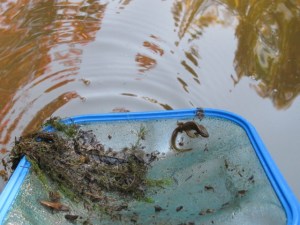
Fall. I’m working on my earth pond, pulling out invasive weeds and dredging stinky sludge and algae. I check every scoop for frogs and salamanders so it’s slow work. And it’s hard work too. The huge pond rake becomes even heavier when dragged through water.

If I don’t do this, the inlet pipe gets clogged up and the pond becomes cloudy with silt and will eventually fill up and return to the mosquito-infested swamp it once was.

salamander in netEarly fall is a good time for a pond clean-up.The frogs and salamanders I disturb are able to swim away and dig themselves into the mud again. If I leave it till later, when it’s much colder, they can be very sluggish and I worry about whether they’ll survive.

Dredge too early, in the spring, and the frogspawn and young salamanders will be destroyed.

Just like with the earth pond, fall is the optimum time for cleaning up a story! This is the time when a story’s process, motivations, scenes, points of view have become overgrown or tangled up in other weedy storylines, or even died off and disappeared into the undergrowth. Continue reading

Writer’s Process: Curiosity And The Contagion Of Looking

Dominion Building, MontrealMy story isn’t working. There are too many characters, too many events. Too much back story. I’ve lost the road map and driven into a swamp.

I need to take a breather. Time for a field trip.

“The brass elevator doors in the Dominion Square Building,” suggests a poet friend.

Go look at an elevator door? Really? Continue reading