Games With Names: Going Against The Expected

coffee cup with 'Marine'When the barista asked me for my name, I was tempted to say ‘Amarantha’.

Amarantha is the name of the main character in the short story “How Beautiful With Shoes” by Wilbur Daniel Steele, which I’d just read.

“Marion,” I said. She wrote it on the cardboard cup as ‘Marine’.

Marine is tall, dark haired, elegant, with striking dark blue eyes. Everyone does a double take when they look into those eyes, even people who know her well, though very few know her really well.

She wears slim skirts, killer heels. High-powered, or at least on her way to being high powered. She has efficient relationships and rarely loses her cool. This is not natural, it was hard come by as she was born a revolutionary, a rebel.

She has a curious gait, a loose limbed, uneven stride as though she’s picking her way over uneven territory – a pitted sidewalk or a tangled moss-veined path through a tropical forest. This gait is the result of a fall when climbing out of her bedroom window one teenage night. She’d broken her leg on the grouping of gnome statues in the flowerbed below and, refusing to give in to her parents by calling out to them for help, she lay there all night, in pain, on the increasingly cold and dewy lawn. By the time the newspaper delivery guy caught sight of her as the newspaper arced from his hand towards the front door, she knew she could bear anything.

Wait!

My mind jumps back to Amarantha. We often do what I’m doing, intuitively create a character who seems appropriate for a name. Or we might search for a name appropriate for a particular character. Continue reading

Constraints And Creativity: A Coffee Break Writing Challenge

Want a fun writing challenge for your coffee break this morning?

Here’s a prompt that will put a sparkle in your synapses and a skip in your step.

Author Sharon Callaghan* came up with it for Greene Writers this week. Impossible, no way, you’re joking, we said. The boundaries seemed just too restrictive. But we were bowled over by what we produced.

Teachers of creative movement learn quickly that constraints help creativity. If you say “OK, so go ahead and make a dance” students talk and yawn, and can hardly get themselves up from the floor. If you say “Make a dance in which you cannot move from the spot, using only three parts of your body” there is the usual resistance for a couple of minutes, then you see only intense focus, concentration and energy…and exciting idiosyncratic, dynamic and Continue reading

Moving to Write: Exploring Flow For Narrative Energy

The idea of flow in writing is usually associated with ‘being in the flow’, that wonderful sensation when words and ideas synchronize, when your concentration is totally focused, making you lose all sense of time, when everything seems to come blissfully together.

Movement offers writers a different way of looking at flow.

For example, these two contrasting types of flow give interest and energy to movement and written narrative alike: Continue reading

Go Squeeze Words

pencils rich in wordsDo you read what artists in other disciplines are writing about?

I am always surprised by how helpful blogs and books about photography or visual arts or theater (or any art form) can be for my own writing or movement creativity.

“Think like a painter. Think like a musician. Think like a surgeon. Don’t think, just write.”  Lisa Moore (Prism International, 2009)

I’ve been receiving ideas, advice, inspiration and encouragement from artist Robert Genn’s always entertaining twice-weekly newsletters for years. His recent passing will be a great loss to those who enjoyed his writings, paintings and teaching.

His daughter Sara, also a visual artist, is picking up the torch and continuing her father’s newsletter tradition. In last week’s newsletter she celebrated her father with a moving and inspiring tribute.

Robert Genn was a master of pithy quotations. One in particular that Sara shared, snagged my attention: Continue reading

The Fine Line of Focus

IMG_4819-1What is your favorite writing moment?

Mine has to be when I’m writing in response to a prompt (could be some detail in a story I’m working on or something entirely new) and I feel that special tug. Something has grabbed me, something that intrigues me, that seems meaningful, even if I’ve no idea what exactly or why. All at once I’m alert, curious to see what’s going to happen, energized, happy as a clam on its favorite rock when the tide is in.

Sometimes this happens after I’ve been free-writing, going with whatever wafts through my mind. Other times it happens when I’ve been concentrating on details of the prompt itself.

Once in the flow, both kinds of focus are needed to keep going: Continue reading

Writing Craft and Community

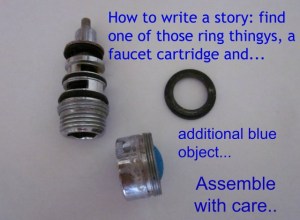
spare parts for writing a storyI was stuck with my novella, not a bad stuck, just a point when I needed to stop, think, and realign characters and plot.

I pulled a couple of craft books from my shelf at random in the hopes of sparking an idea, or finding a new way to see my material.

  • “Naming the World” (ed) Bret Anthony Johnston
  • “Burning Down The House” Charles Baxter
  • “Creating Fiction” (ed) Julie Checkoway

Writer Unboxed

Not an hour later, I was reading a blog post from Writer Unboxed about the issue of craft books. Although many people shared their favorite craft books and inspirational authors, a number of comments expressed quite a lot of antagonism towards craft books – e.g., craft books are only written to make money; you can’t learn writing from a book…

I was very surprised because I think of writers/artists as curious people and would have thought they would want to see what other Continue reading

Golden Rain And Other Inspirations

When spring insists on remaining winter, it’s wonderful to have such a rich arts week! So great for enlightening our own creative process…

Golden rain

In Lin Hwai-min’s “Songs of the Wanderers” performed by Cloud Gate Dance Theatre of Taiwan, three and a half tons of rice stream down as curtains of golden rain, splash up in high gleaming arcs and, in falling, transform into the shifting sands of a desert.

sun up in Sahara © Dr. J. HockAn ancient tribe struggles through this desert, leaning on their crooked staffs which have what look like a little leaf or bird at the top but are in fact tiny bells.
To one side, a monk or Buddha figure in white. Eyes closed, hands together in prayer. A constant column of rain pings off his head and hands and white robes. He remains absolutely motionless. Surely a statue. No. At curtain call he receives thunderous applause for his 90-minute stillness. Continue reading

In Search of the Perfect Ending

The End(s)Why am I writing about story endings when the very thought makes me want to whimper and hide my head under my pillow?
Endings! Endings! Oh the agony! But oh the sweetness when you get the right one!

Continue reading

Writing Advice From The Sword: What Fencing Can Teach Writers

unpacking sabersWhat’s a writer to do when winter just goes on and on and it’s March and there’s still snow on the ground and minus temperatures? Take up fencing.

As a movement artist-educator I’ve always believed that changing and challenging your usual ways of moving is an effective and pleasurable way to energize yourself and boost your creative thinking.

Fencing is certainly making my brain sizzle. And there’s the bonus of getting writing advice too!

1. Don Protective Gear Continue reading